
Event guide · Mon, Nov 16, 2026
Twelfth Night in New Orleans: Carnival opens and king cake season begins
On Wednesday, January 6, 2027 New Orleans does the neatest trick in its calendar: Christmas ends at sundown and Carnival begins an hour later. King cake goes on sale that morning and not a day before, a medieval procession for Joan of Arc walks the French Quarter at half past seven, and a streetcar full of masked Phellows rolls down St. Charles Avenue to announce the season. How the opening night works, where the first slices are found, and how the five weeks from here to Mardi Gras Day build.
Most cities take January off. New Orleans uses the sixth of it to change seasons in public, in a single evening, with cake. Twelfth Night, the Feast of the Epiphany, Wednesday, January 6, 2027, is the official first day of Carnival, the start of the five weeks that end on Mardi Gras Day, Tuesday, February 9. Nothing about the night is a warm up act for the big parades, and visitors who treat it as one miss the point: this is the city's own opening ceremony, small, strange and entirely serious about its pleasures. Bakeries sell the first king cake of the year that morning. By dark, a saint is being marched through the French Quarter by torchlight and a streetcar full of satirists is announcing the season on St. Charles Avenue. If you want Carnival the way New Orleans keeps it for itself, this is the night to be here. For the season's peak, the float parades and the final week, our Mardi Gras first timer's guide does that planning; this piece stays where the season starts.
What Twelfth Night actually is
Epiphany marks the visit of the Three Kings to the infant Jesus, twelve nights after Christmas, and New Orleans, a city built by Catholic France and Spain, kept the feast and built a season on it. Carnival here is not a day but a span: it opens on Twelfth Night every year, without regard to where the date falls in the week, and it closes at midnight on Mardi Gras Day, with Ash Wednesday and Lent on the other side of the line. In 2027 that span runs from January 6 to February 9, long enough for the season to have a plot: an opening night of walking processions and streetcars, weekends of smaller krewes finding their feet, and only at the end, from February 3, the nightly run of the great float parades. January's part of that plot is the conspiratorial part, when the costumes are handmade, the crowds are mostly local, and the whole thing still feels like a secret the city is letting you in on.
First, the cake
King cake season has a hard edge, and Twelfth Night is it. The rule, kept by bakeries and enforced by grandmothers, is that king cake is not eaten before January 6; cakes appear in bakery cases that morning and vanish again after Mardi Gras Day. The cake itself is a braided ring of cinnamon brioche under icing and sugar in purple, green and gold, the colors of Carnival, with a small plastic baby tucked inside or alongside. Whoever gets the baby in their slice owes the next cake, or hosts the next gathering, which is how one cake in an office on January 6 becomes a cake a week until February. It is a subscription you eat.
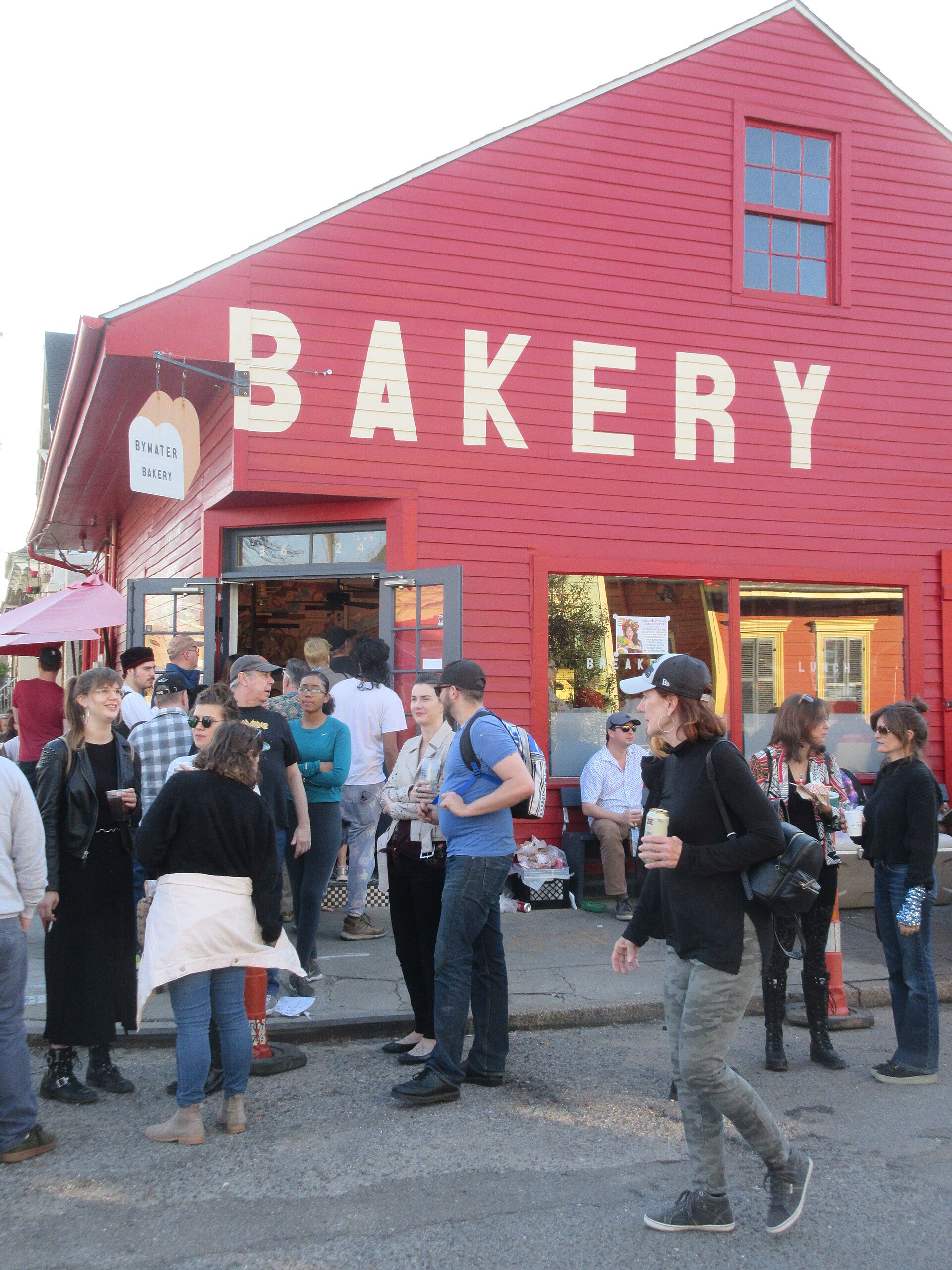
Where the first slices are found is a morning sport of its own. Dong Phuong, out on Chef Menteur Highway in New Orleans East, draws the famous pre dawn lines for its cream cheese and pecan cakes. Bywater Bakery, the red building in our hero photograph, turns King's Day into a street party, with live music and its own kick off crowd, and bakes savory versions alongside the sweet. Manny Randazzo's, Haydel's and Gambino's are the traditional names Metairie and the city argue over, La Boulangerie covers Uptown, and neighborhood cafés all over town put out small cakes for the day. Go early, buy two, and eat the first slice standing up in the bakery's orbit, the way the queue does. One more slice is built into the evening itself: the Joan of Arc procession below stops for a king cake ceremony in front of Jackson Square, and the krewe invites the public to bring a cake and take their first bite of the season with the parade.
The French Quarter at half past seven: Joan of Arc
The night's centerpiece in the Quarter is the Krewe de Jeanne d'Arc, whose 19th annual procession the krewe has announced for Wednesday, January 6, 2027 at 7:30pm sharp, finishing around 9:30pm. It is a walking procession, handmade and medieval, celebrating the birthday of St. Joan of Arc, the Maid of Orléans in France and, by adoption, the Maid of New Orleans, whose gilded statue stands by the French Market. Expect knights, angels, dragons, banners and a young Joan on the route the krewe expects to follow, the same as last year's: it forms at Bienville and Front Streets, pauses at the Historic New Orleans Collection on Chartres Street for a toast to its royalty in English and French, crowns its king with the king cake ceremony at Oscar Dunn Park, across from Jackson Square, where the public is invited to fill the amphitheater risers, sings happy birthday to Joan at her statue, and ends at French Market Place and Barracks Street.
Two honest caveats, because the krewe itself prints them. The route is not yet finalized with the police and the permit had not been issued when the krewe published it, so check the krewe's site in the last days before you stake out a corner. And the sword blessing that usually happens at St. Louis Cathedral is planned again for St. Mary's Church in the Old Ursuline Convent on Chartres Street, because the Cathedral is under scaffolding. None of that dims the thing itself: a torchlit, theatrical, family friendly procession that treats a fifteenth century saint as a New Orleans local, which, by now, she is.
Uptown at seven: a streetcar full of Phellows
At the same hour, the season opens Uptown in the opposite style. The Phunny Phorty Phellows, who spell everything with a ph on principle, are the self appointed Heralds of Carnival. Their krewe first took to the streets in 1878, faded out by 1898, and was revived in 1981; since 1982 their Twelfth Night streetcar ride has been the season's starting gun. The standing form of the evening, as the krewe's own site tells it, is a gathering at the Willow Street Car Barn by Carrollton Avenue, a Carnival Countdown, and at 7pm sharp a costumed, masked load of Phellows boards a decorated St. Charles streetcar, the Storyville Stompers aboard as the band, and rides the line down to Canal Street and back, tossing the season's first beads to whoever is standing on the neutral ground. The Funky Uptown Krewe follows on a streetcar of its own, and across town the Société des Champs Élysée rides the Rampart streetcar line, so for one stretch of the evening three streetcars in three parts of the city are all, officially, parades. The Phellows publish no 2027 ride details yet beyond the standing tradition, so treat the timing as the form of the night rather than a confirmed schedule, and confirm nearer the day. You cannot do both openings properly: Joan walks at 7:30 in the Quarter, the Phellows roll at 7:00 Uptown. Pick one, commit, and let the other be next year's reason to come back.
How the season builds from here
Twelfth Night is a door, and the fortnight behind it is deliberately gentle. The Twelfth Night Revelers, parading in ballrooms since 1870, hold their private ball the same evening and choose a queen by golden bean in a cake, the old way. Then the walking krewes take the January weekends: Krewe Mosaique in the Quarter on Saturday, January 9 on the current tentative calendar, the science fiction army of Chewbacchus a week later, Bohème and the gloriously rude Krewe du Vieux in the final January stretch, with dates still labeled tentative by the parade listings and worth confirming before you book around them. The big floats, the super krewes and the nightly parades belong to February, and the season closes with Rex and Zulu on the morning of Tuesday, February 9. The shape is the pleasure of a January trip: you get the rituals at full strength and the city at half crowd, dinner reservations that exist, and king cake in its first, freshest weeks. The days around Twelfth Night are also some of the best sightseeing days of the winter, cool and walkable, which is where the pass arithmetic comes in.
Get the Go City New Orleans passvia Klook · affiliate link
A practical plan for the night
Arrive the day before if you can, so January 6 is not a travel day: the cake queues are a morning event and the processions are an evening one, and both punish a late start. Eat an early dinner, because the Quarter's kitchens fill once the procession ends around 9:30pm. Dress in layers; January in New Orleans averages highs in the low sixties Fahrenheit and lows in the mid forties, and a riverside corner at night is colder than the forecast sounds. Base yourself in the French Quarter or at its CBD edge for this trip: Joan's route, the cake bakeries' city branches and the streetcar downtown loop are all at walking distance, and the Uptown ride can be watched where the line meets Canal Street if you chose Joan and still want a sight of a heralded streetcar. The stay search below is set to the Twelfth Night window itself; the booking page rolls dates as you need.
Book a place to stayvia Booking.com · affiliate link
Set a New Orleans What's On alert and we will email you when the Joan of Arc route is finalized, when the Phellows publish their ride, and as the January parade calendar firms up. Carnival does not begin with a bang in New Orleans. It begins with a slice of cake, a saint in the street and a streetcar full of jokers, and it is better that way.
More reading on the articles page, or go straight to the events calendar.